WET for clinicians
Written Exposure Therapy (WET) is a brief, well-researched treatment for PTSD. It involves one session of psychoeducation and five 30-minute sessions of writing (or recording) about the main traumatic event. Sessions are usually weekly but can be twice a week. The first three sessions focus on details of the trauma; the last two focus on how the trauma and PTSD affect the person’s life.
A supervising clinician (SC) may stay in the room or leave. The SC reads the writing after the client leaves, gives feedback before the next session, and suggests topics for the next session. There is no homework, which helps reduce dropouts. Patients can be given their writing or it can be destroyed.
WET is designed to be used by non-psychologists, is efficient and effective, and is supported by many studies, including randomized trials. It’s offered to adults and adolescents with PTSD. After the five sessions, using the PCL-5 can help check progress; a score below 33/80 suggests substantial improvement.
PTSD is ongoing mental and emotional distress after exposure to death, serious injury, or sexual violence. Common signs include poor sleep, repeated recall of the event, and feeling detached from others and the world. If the event does not meet those criteria, it is not PTSD.
Screening tool for clinicians and clients
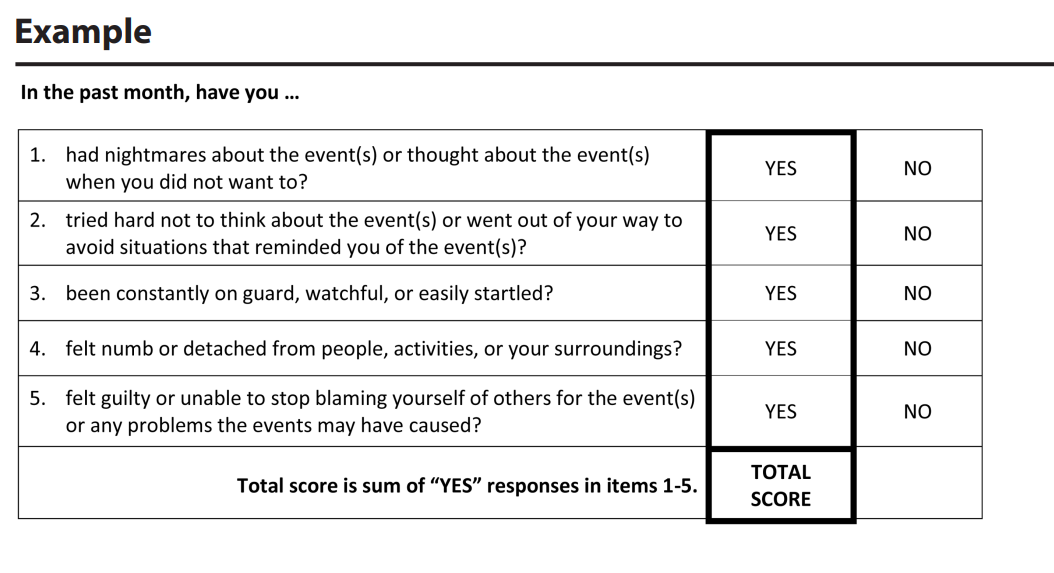
In general, a score of 3/5 means the client could have PTSD and 4/5 or 5/5 very likely to have PTSD
This can be confirmed by asking the client to do a PCL-5 questionnaire (with 20 questions) and a score of > 33 means PTSD is likely (this takes 5-10 minutes)
Advice for patients
Other WET Resources
Sloan WET Session Guides — Collaborative Aotearoa
Day 1 to Day 5 (35 pages)
SUDs questionnaire — Collaborative Aotearoa
Single-item scale 0–100 (rate before and after each writing session)
LEC-5 (Life Events Checklist for DSM-5) — Collaborative Aotearoa
Trauma history questionnaire
PHQ-9 — Collaborative Aotearoa
The 9-item depression screening questionnaire
EMOQOL (Emotional Quality) / Burns Depression Questionnaire — Collaborative Aotearoa
Single-question mood rating: ≥ 60 = normal mood; < 60 = low mood
WET Sentence Prompts — Collaborative Aotearoa
Prompts to help clients write important details
PCL-5 (PTSD Checklist for DSM-5) — Standard form
Use to confirm PTSD diagnosis: administer before the first writing session and after the fifth (final) writing session
Notes:
Materials described as “Collaborative Aotearoa” are available as 35-page booklets or individual forms as listed.
SUDs, EMOQOL and PHQ-9 are brief rating tools to be used before/after sessions for monitoring.
Newsletter
Sign up and receive my update every two months.